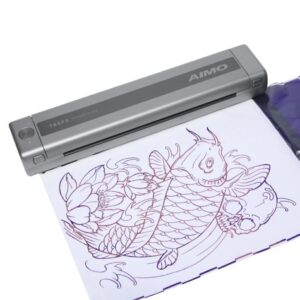
Yaba’s AIMO A4 thermal printer is our starting recommendation for a studio that wants to send digital artwork from a phone, tablet or computer without managing liquid stencil ink. Choose our P-19 thermal option when rechargeable power and a wireless mobile setup are part of the requirement. Our dedicated inkjet stencil ink and paper offer another route for a fixed workstation, provided the required new compatible printer and its ongoing care fit the studio.
The decision between thermal vs inkjet tattoo stencil printers should therefore settle an actual equipment-and-consumables combination. Même si supplies both thermal equipment and dedicated inkjet consumables. We recommend comparing their output on the same stencil before choosing a route for a detail requirement; neither printing technology alone proves that the result will be more useful for your work.
Yaba thermal equipment removes the liquid-ink task
The AIMO A4 transfers digital artwork without a liquid-ink reservoir
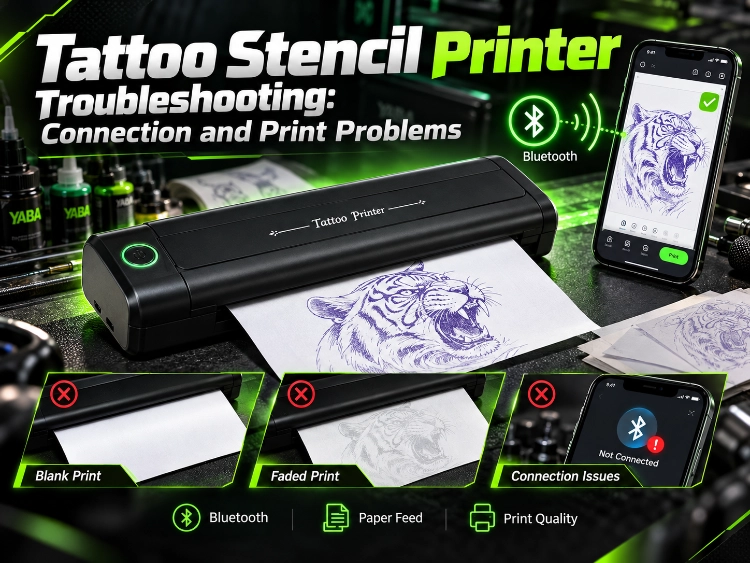
Notre AIMO A4 thermal stencil printer uses ink-free thermal transfer and accepts artwork from mobile phones, computers and tablets. Heat acts on compatible tattoo transfer paper to create the design. The paper carries the marking material, so the studio does not have to fill a reservoir with liquid stencil ink for this route.
That is a practical reason to choose the AIMO when the job is direct digital-to-stencil printing. The benefit comes from the way the mark is formed, rather than from a claim that thermal is always sharper or cheaper. You still need the correct transfer paper and the connection supported by the equipment you buy.
The AIMO has a 210 mm paper width and a 203 dpi print specification. The width helps establish whether the intended sheet path is suitable. The resolution describes the print specification; it does not guarantee that every fine gap or dense area in an exported image will remain readable. Use a sample of your own design to settle that question after the basic paper and device requirements fit.
The P-19 adds a specific portable printing option
Notre Imprimante à pochoir Bluetooth P-19 combines thermal printing with a rechargeable 1500 mAh battery. It supports a wireless mobile route and a Type-C computer connection. For a guest spot, that combination gives you a concrete model to evaluate when a continuous mains connection at the print position would be inconvenient.
Choose it for that actual requirement, rather than treating all thermal printers as automatically portable. Confirm the sending device, application or computer connection and paper format you will use. A battery does not remove those dependencies, and its capacity should not be turned into an unsupported promise about how many appointments or pages it will cover.
For a studio that prints only occasionally, we would start with the thermal route unless an inkjet sample shows a benefit the work requires. The AIMO’s ink-free mechanism avoids a separate stencil-ink filling task. The P-19 is the thermal candidate when mobile use also matters. Neither recommendation means that the printhead, rollers or paper path can be neglected.
Our dedicated inkjet route starts with a new printer
The 120 ml stencil ink has an equipment condition worth settling first
Notre 120 ml dedicated inkjet stencil ink is intended for a new printer, with Epson EcoTank models recommended for the setup. This is a condition of this particular ink route. An existing office machine already filled with document ink should not be counted as ready equipment for it.
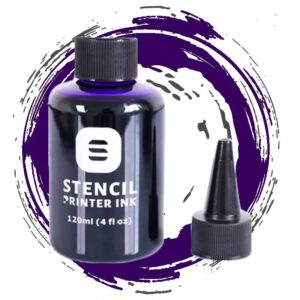
The useful purchase is a printer assigned to stencil work, the stencil ink and the appropriate media together. Establish the exact printer model and its new, unfilled condition before ordering the consumables. The equipment manufacturer’s filling arrangement and setup instructions still apply; the word “EcoTank” is not a substitute for identifying the model.
This distinction keeps an apparently inexpensive consumable purchase from becoming an incomplete setup. If the studio will not provide a new dedicated printer, our thermal equipment is the more relevant route to compare. If a new compatible printer is already planned, the inkjet option can be assessed on its actual output and care requirements.
The ink and paper must belong to the same printing route
We supply papier pochoir pour imprimante à jet d'encre for the dedicated inkjet approach. An inkjet deposits liquid stencil ink onto suitable media. Thermal transfer paper and inkjet media should therefore be ordered by their intended system, rather than treated as interchangeable because both packages say “stencil.”
Keep the printer, ink and paper names together when requesting this combination. A good sample made with another ink or another sheet does not establish the result of the items being quoted. Ordinary office ink also should not be substituted for dedicated stencil ink just because the printer can produce an image with it.
Inkjet adds a liquid-ink path and its care requirements. Check the relevant instructions for use and idle periods before choosing it for an intermittent printing schedule. Thermal avoids that liquid-ink task, while still requiring model-appropriate head, roller and feed care. The trade-off is about the work the studio can sustain, not a maintenance-free claim for either route.
Actual stencil output decides which route earns its place
A matched sample makes the systems comparable
Once the equipment and media fit the job, compare the AIMO or P-19 route with the dedicated inkjet combination using the same exported design at the same final physical size. Include the features that matter to the artist: lettering counters, close parallel lines, small enclosed spaces or tonal landmarks that the stencil must retain.
Inspect the source file first. A contour already lost in the export cannot be recovered by buying another printer. Then inspect each physical sample for readable landmarks and gaps. If one sample has been enlarged, its clearer spacing cannot fairly be credited to the printing technology.
Record the exact printer, media, ink where applicable, and settings used for each sample. That makes the result useful for an order. It also prevents a later media substitution from being assumed equivalent merely because the printer is unchanged. Samples establish the proposed combination, rather than the entire category of equipment.
More printed detail does not always make a better working guide
A stencil needs to preserve the information the artist will follow. Dense tone can obscure a contour; removing all tone can discard a landmark the artist needs. Define the useful result before comparing the two routes, particularly when a portrait or detailed design is the reason for considering inkjet.
Choose the dedicated inkjet route when its matched sample provides a working benefit that justifies the new printer and care routine. If the thermal sample already gives the required readable guide, an inkjet setup has not earned a place simply by being described as more advanced. This is the point at which actual output should change the equipment decision.
A clean paper print is also not a complete transfer-performance test. Where that behaviour matters, follow the media and ink instructions and obtain an appropriate professional evaluation. No result from this buyer comparison should be presented as a Yaba laboratory test or a guaranteed outcome on a person.
The order should match the studio’s printing routine
Each Yaba route answers a different equipment requirement
Use the route that fits the work and can be replenished with the right consumables. The following comparison identifies what to order and what would change the recommendation.
| Studio requirement | Yaba route to evaluate | Reason and limit |
| Direct digital printing without liquid stencil ink | AIMO A4 with compatible thermal transfer paper | Ink-free thermal transfer avoids a filling task; verify the actual device path and sample output. |
| Thermal printing for mobile work | P-19 with its supported paper and sending device | Its rechargeable battery and wireless option support that use; no runtime is assumed. |
| A fixed dedicated inkjet workstation | Our 120 ml stencil ink, matching inkjet media and a new compatible printer | This particular ink requires a new printer; choose the route when output and upkeep justify it. |
The equipment order and a consumable refill are different requests. Identify which is needed so that a paper or ink quotation is not mistaken for a complete printer setup. Keep any alternative combination separate until its compatibility has been established.
Cost should be compared against accepted stencils
Use current equipment and consumable quotations to compare the routes. Include the compatible paper, required ink and any maintenance consumables, alongside rejected prints. Ink volume or sheets per pack alone does not establish the cost of useful output.
Apply the same acceptance standard to both samples. A cheaper sheet does not reduce usable-print cost when more sheets are discarded. Equally, a more expensive setup cannot justify itself with a detail advantage the studio does not use. Calculate from representative work instead of assigning an automatic cost advantage to either technology.
Repeat supply matters after the first order. Retain the selected paper and ink identity with the equipment record, and reorder those exact items or an explicitly confirmed alternative. This keeps the initial system decision intact as the studio replenishes consumables.
Conclusion
Send Yaba the chosen thermal or dedicated inkjet route, exact printer and sending device, stencil format, printing frequency and equipment or consumable quantities. For the inkjet route, include whether the intended printer is new and unfilled. That request gives the discussion a concrete equipment-and-media combination to settle, with the operating conditions understood before separate items are purchased.
FAQ
Q1: Which Yaba option should a studio evaluate for mobile printing?
A1: The P-19 is a specific thermal candidate with a rechargeable 1500 mAh battery and wireless mobile printing. Confirm the intended device connection and media format as part of the choice. Battery capacity alone does not establish a page count or session runtime.
Q2: Can I put Yaba’s 120 ml stencil ink into an existing office printer?
A2: This ink is intended for a new compatible printer, with Epson EcoTank models recommended. An office machine already filled with ordinary ink does not meet that starting condition. Identify the exact new printer and matching inkjet media before preparing the setup.
Q3: Should I choose inkjet just because my designs are detailed?
A3: Compare the intended designs at final size using the exact systems and consumables under consideration. Choose inkjet when its readable output provides a benefit worth the dedicated printer and care requirements. If the thermal result already meets the work’s needs, detail alone is not a reason to add inkjet.