The film on your skin is a Même si film, and it answers through its own product page first. The product in the drawer was sold with the instructions on that page. The page states that the film stays on for up to 7 days. The same page gives the first piece a shorter job: a reapplication, when there is one, happens after the first 12 to 48 hours, on skin cleaned and dried. First piece in hours. Later pieces in days. The two numbers are read in that order: the hours number belongs to the piece that went on at the studio, and the days number to the wear that follows it.
One instruction outranks both numbers. Your artist saw the skin, the placement and the amount of work that went in. An artist’s own day count, given in the chair, is the count for that tattoo. The figures below are for the hours when the artist is not there to ask, and they are the figures from the film page, repeated where they apply.
First piece or second piece: the count starts differently
The first piece takes the heaviest weeping, so it is the short one
A fresh tattoo weeps. Plasma, ink and lymph, most of it in the first day, a fraction of that on the second, and by the third day a settled piece has largely stopped. The first piece of film collects the first-day output under a sealed cover, where it stays in view the whole time it is gathering. By the evening of day one the film has usually clouded. By the next morning the tattoo can sit behind a dark layer of its own fluid, thick enough that the linework reads blurred through it, and a client who has not worn film before, meeting that layer at midnight, reads it as the tattoo leaking out of the skin. It is the ordinary first stage, collected on top of the piece instead of into a bandage or a bedsheet, the other two destinations for the same fluid, and the reason clients who healed under cling film never saw it gathered in one place.
Our page measures that first piece in hours, a change inside the first 12 to 48, because the collecting job is finished early. Studios publishing their own instructions put the first change anywhere from 8 hours to 2 days, a spread worth knowing about before it frightens anyone: the numbers differ, the order does not, and the order is a short first piece followed by the longer wear the day counts describe.
The second piece is the long wear the day counts describe
The second piece, when there is one, goes onto a tattoo that has largely stopped weeping. That is why it can be counted in days at all. Most studio counts published for that piece land at 3 to 5 days. Our film page states up to 7 days. The 7 days is a ceiling on that page, and it reads with the conditions the same instructions assume: the seal intact for the whole run, the skin underneath calm, the edges where they were put. A piece that reaches day three with its seal gone has finished at day three, on the schedule the next section describes.
Take it off now: signs that cancel the calendar
A protective film works as a sealed cover. The seal is the product, as much as the film is. An edge lifted far enough for shower water to travel under it has opened the cover. Pressing that edge down with a thumb does not close it. Adhesive that has let go, and been touched, and been pressed, is not the adhesive that was applied at the studio. That is the mechanical fact under every early-removal instruction, ours included. A sealed piece at day five is inside its stated use. A lifted piece at day two is outside it, and the day count is read after that fact, not before it.
Fluid tells the same story by position. Fluid inside the film, under an intact seal, is the first piece doing the collecting it was applied for. Fluid outside the film, running down the skin, is a seal that has already failed, and the piece comes off when that is seen, at hour ten or at day four, whichever the seal chooses. A wide area of film lifted and unwilling to lie flat reads the same way. So does skin that objects: redness and itching that start at the film’s border and spread outward past it, a tattoo hotter than the skin around it, soreness climbing across a day instead of settling. A first piece that leaves at hour ten because it leaked has still covered the heaviest weeping that tattoo was going to do, which is the work it was applied for.
After an early removal the steps are plain: the tattoo is washed, the skin is dried, and then the choice arrives that the sink section below walks through, between a fresh piece, if the skin is clean and fully dry and the first change window is still open, and the wash-and-moisturise routine for the ordinary days. Two findings sit outside this article and are named here so they are not mistaken for routine: redness spreading well past the piece, and heat with swelling that grows, and discharge with a smell to it make a same-day conversation with the artist or a medical professional, because a product page is the wrong place to ask about any of the three.
Small line work and large pieces do not share one timetable
Small line work weeps less and can use the full window
A small line piece, a name in script, a symbol the size of a coin, gives the film an easy assignment: the fluid output across its first day is slight enough that the piece stays largely clear instead of clouding, the seal sits under little strain, and the wear runs close to the stated figures, with a change inside the first window where a second piece is planned, or a single piece carried towards the longer end of its range while it stays sealed and the skin stays quiet. Small pieces are also where the roll format of the film is at its simplest. Our gloss film is sold as a roll 10 m long and 15 cm wide, at $11, and a small tattoo is one cut from that roll with margin on every side, sized the way the application steps on the page describe, against the grid lines printed for cutting.
Large colour pieces fill the first piece faster
A large, saturated colour piece, a full forearm panel or a back piece filled in one sitting, can produce in its first twelve hours roughly the fluid a small line piece produces across two days, and the timetable bends accordingly: the first piece fills, its edges carry the strain of the fluid moving underneath, and the change arrives at the early end of the 12 to 48 hour window, on heavy pieces sometimes ahead of it. The film for such a piece has to be planned by size before the sitting ends, not at the bathroom sink afterwards, because the roll is 15 cm wide and a tattoo wider than the roll is covered in overlapping strips, each overlap adding an edge, and each edge a place where the seal can start to go on a piece that is already producing more fluid than a single width was sized for. The matte version of the film is listed on its page in two sizes, 10 cm by 10 m and 15 cm by 10 m, priced between $13.99 and $16.99, against the single 15 cm width of the gloss roll. Width is chosen against the largest piece the film will have to cover, the same way the length of a bandage is chosen, and for the same reason.
Placement shortens every timetable in this article. Film over an elbow is flexed each time the arm bends. Film on a ribcage moves with every breath. Film in the fold of a wrist is worked by the joint all day. The edges of those pieces loosen on a schedule that owes nothing to fluid and nothing to day counts. On a joint the seal is the schedule, checked by eye in the morning rather than counted, because the day counts in every instruction were written for skin that holds still.
A second piece or not: three checks at the sink
The first piece is off. The tattoo is washed. The skin is dry. The second-piece decision is made standing there, on three checks, in this order.
Time first, because time can close the question alone. The window on the film page is the first 12 to 48 hours. Skin inside that window, cleaned and dried, can take a fresh piece. Skin past the window has started closing in the open air. It is no longer a surface for adhesive.
Fluid second. A tattoo still weeping enough to cloud a new film within hours has not finished the collecting stage. A second piece on that tattoo is a short shift. The wash routine below does the longer work.
Skin third, and skin can veto the other two. Calm skin that sat under the first piece without complaint can take a second piece. Skin that came out of the first piece red in the film’s exact outline has already answered the adhesive question. That skin gets the routine with a cover that contains no adhesive. That cover is the subject of the section after next.
Removal: warm water, peel it back over itself, slow
The removal instruction on our film page is one line, and it is usually carried out in the shower, where warm water can reach the adhesive while both hands stay free for the peeling. Read it as printed: lift a corner of the film, pull gently along the surface of the skin so the film does not break, and use warm water where it resists. The peel runs back over the film itself, low against the skin and slow, the film folding away from the tattoo rather than being lifted off it at an angle, because the film is 0.01 mm thick and holds across its whole area at once, and a dry, fast pull drags on fresh skin across that whole area at the same moment. Studio instructions for this kind of film, wherever they are published, keep returning to the same two elements in different words, warm water and patience, because the adhesive gives up to the first and the skin is protected by the second.
Two things seen during a removal alarm people who were not told about them. Ink sits on the film as it comes away, dark against the transparent sheet. That ink was already leaving the tattoo. It travelled in the plasma the film collected. Its presence on the film is the collecting having worked, not colour pulled out of the skin. The second is the tattoo looking dull in the first minutes after the film leaves, flat and a little blurred at the edges; a surface kept under a cover for three or four days is not judged fairly at the sink under bathroom light, and the judgement belongs to daylight, at arm’s length, several days later.
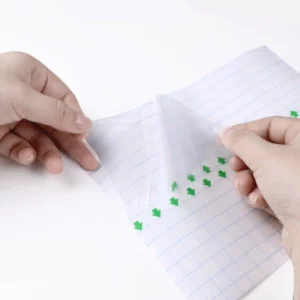
The application steps on the same page run in reverse to the removal, and a second piece follows them in their printed order: the roll is cut to size along its grid lines, the backing paper is peeled away, the film is pressed onto clean, dry skin and smoothed into place, and the surface layer is peeled off last, leaving on the skin the thin film that does the wearing.
After the film: washing, then the gel step
The routine after removal is short, and its order is the routine. The tattoo is washed, with clean hands. It is patted dry, with a clean paper towel or a cloth that has not been hanging by the sink all week, rather than rubbed. It is left to air for a few minutes, until the surface is dry to the touch, and then given its product in a thin layer. From there the piece enters its ordinary pattern for the next two weeks or so: washed, dried, moisturised in thin layers, left alone between times. The product choice inside that routine is where our shelf divides, on a line printed on one of the two pages.
Where a second piece of film is not going on, the sealant gel is the product on our shelf built for exactly that hand-off. Its page describes a gel that is applied wet to the fresh tattoo and dries within minutes into a protective skin of its own, one that later washes off under warm water without pain, and the same page states, as a property of the product, that it contains no adhesives and no latex. That property is the reason the gel appears in this article at this point and not in a comparison: skin that has finished wearing adhesive film, and skin that reacted to the adhesive while wearing it, can still be given a cover, by a layer that is washed away at the sink rather than peeled away from it. The gel is sold as a 30 ml tube at $1.69 and in a box of three at $5.29. Beyond the first days, the moisturising part of the routine belongs to the aftercare ointment, a balm priced at $4.99 whose page places it before, during and after the tattoo process, with the vitamin A&D ointment in sachets of 100, at $3.99, serving the studio end of the same shelf. Whether gel or film suits a whole routine better, as a system, is a different question, and it has its own article, on choosing sealant gel or a second skin film for a daily routine. The question in this article is narrower and ends at the sequence: film while the piece is fresh and weeping, washing when the film comes off, gel where a cover is still wanted and adhesive is not.

Conclusion
The film page gives two numbers. They are different kinds of number, and the difference is most of what there is to understand. The first number is in hours: 12 to 48, the window for changing a first piece whose job was collecting. Heavy pieces finish that job early. Broken seals finish it earlier. The second number is in days: up to 7, the ceiling the page states for a piece, with most studio counts for a settled piece landing between 3 and 5. Every count in this article is cancelled by the same three events. A seal that breaks. Fluid that escapes. Skin that objects. A piece that stays sealed and quiet is kept for its full count. A piece that does not is taken off at whatever hour it declares itself, and the tattoo is washed, and the routine takes over, with the gel standing by for skin that still wants a cover and has finished with adhesive. The film in both finishes, the gel and the rest of the shelf are listed together in our medical and aftercare range. The pages quoted in this article live there.
FAQ
Q1: When should I stop putting second skin on my tattoo?
A1: When the tattoo has stopped weeping and the skin has begun closing in the open air, which in the sequence stated on our film page means the fresh pieces belong to the first 12 to 48 hours and the routine of washing and moisturising belongs to everything after. A piece applied inside that window is the product being used as its page describes. A piece applied days later, onto skin that has already started closing, is adhesive laid on a healing surface it was not described for, and it is the point where the film stage of the aftercare ends.
Q2: Can you leave second skin on for too long?
A2: Yes, and the day count is only half of how it happens. Our page states up to 7 days for a piece, read with a seal that has stayed intact and skin that has stayed calm for the whole run. A piece kept on past a broken seal, or over skin that is reddening and itching under it, is being left on too long at day two as surely as at day six, because the cover stopped being sealed and quiet, which were the conditions the longer count was granted under.
Q3: Can I take second skin off after 1 day?
A3: A first piece can come off at one day without breaking any instruction on our page, because one day is 24 hours and the change window stated on that page runs from 12 to 48, and a piece that has leaked or lifted belongs off sooner than one day, at whatever hour its seal went. What follows is the sink order used throughout this article: the tattoo is washed, the skin is dried completely, and then the three checks decide between a fresh piece, while the window is still open, and the wash-and-moisturise routine. A first piece removed at the one-day mark is the product being used on its own printed schedule, not a schedule being interrupted.
Q4: Is 4 days long enough for second skin?
A4: Four days is inside the 3 to 5 days most studio instructions publish for a settled piece, and under the 7 days stated as the ceiling on our film page, so as a count it needs no defending. The count is not the whole answer, though, because it describes a piece that stayed sealed and quiet for those four days. A piece that leaked on day two and was worn to day four anyway has not been worn for four days in any sense the instructions mean.
Q5: Can I shower with second skin on?
A5: The film page states the film is waterproof, and its own removal instruction assumes warm water at the skin, so a normal shower is inside the product’s described use and is in fact where removal usually happens. Soaking is a different exposure from showering: baths, pools and long submersion work water patiently at the edges of the piece until the seal gives, and once the seal has given the wear is over, at whatever day the count had reached.