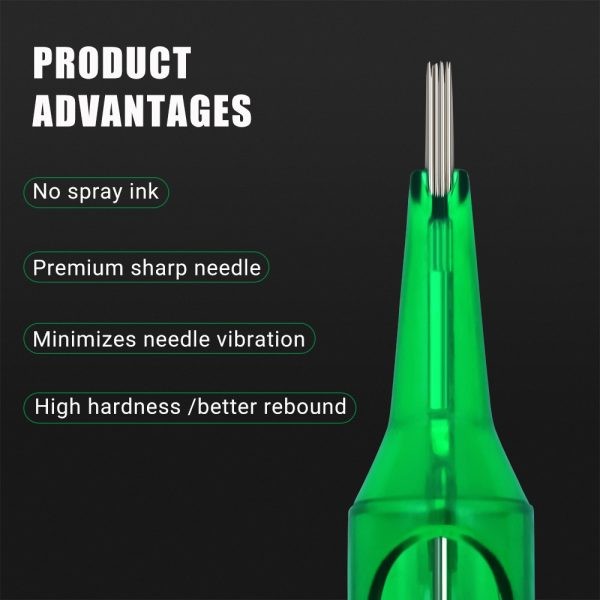
Bugpin is a diameter class. The word states how thick each individual needle is, and it says nothing about the grouping, the taper or the brand. A round liner, a round shader and a magnum can all be built on bugpin-diameter wire.
Suppliers use the word two ways, and that is where ordering mistakes start. Most catalogues call the #10 diameter, 0.30 mm, a bugpin, and many extend the name to #08 at 0.25 mm. A smaller group of suppliers reserves the word for #08 alone and treats #10 as a regular mid size. One word can therefore stand for two diameters that differ by 0.05 mm, and that difference is visible in the line a grouping lays down. The code printed on the box settles the question, because the code states the diameter in its first two digits.
The three diameters behind the name
The names come from insect-mounting pins, which were graded 0, 00 and 000 at 0.35 mm, 0.30 mm and 0.25 mm. Artists adopted those fine stainless pins for detail work, and needle makers kept the grading when they standardised tattoo needle wire. The modern codes work as follows.
| Code | Diameter | Trade name | Typical role |
|---|---|---|---|
| 12 | 0.35 mm | Standard | Bold lines and fast saturation |
| 10 | 0.30 mm | Bugpin, double zero | Fine lines and layered black and grey |
| 08 | 0.25 mm | Super bugpin, triple zero | Finest lines and the softest shading builds |
Every cartridge code follows the same pattern: the first two digits give the diameter, the next digits give the needle count, and the letters give the grouping type. A box marked 1007RL holds seven 0.30 mm needles in a round liner grouping. A box marked 1207RL holds seven 0.35 mm needles in the same grouping. The grouping is identical and the wire is not, so the two boxes tattoo differently.
Read any listing by its codes rather than its headline. On Wenngleich, the Pro-Rundlinerseite runs order codes from 0401RL to 1218RL on a single listing, including 08 and 10 diameter codes alongside the 12 codes. The diameter that arrives is the diameter in the code you select, so a quote or an order that says only “bugpin liners” leaves the most important digit unspecified.
What changes when the wire gets thinner
Diameter changes a grouping in two ways that matter at the machine. The first is width. Seven 0.30 mm pins packed in a liner span roughly the width of five 0.35 mm pins, so a 1007RL lays a line closer to a 1205RL than to a 1207RL. An artist who switches from #12 to #10 and keeps the same needle count gets a finer line than the count suggests. Order by the line width you want, and treat the count as the second variable.
The second change is ink delivery. Thinner wire carries less ink per pass, so black and colour build in layers instead of arriving in one pass. For black and grey work that layering is the point, because each pass adds a controlled step of tone. For a large solid field the same property costs time, and the extra passes work the skin again. Each thin pin opens a smaller channel than a standard pin, but that advantage disappears once the area needs three passes instead of one.
Bugpin says nothing about taper
Taper describes the length of the ground point at the tip, and it is specified separately from diameter. Short tapers run about 2 mm, medium tapers about 3 to 5 mm, and long tapers about 5 to 6 mm, with extra-long points beyond that. A cartridge can be #10 in diameter with a long taper, or #12 with a short taper, and the two choices affect the work independently.
This matters when a quote mixes the two terms. A supplier who answers a taper question with the word bugpin has answered a question you did not ask. Check the taper specification before you order. Yaba Pro cartridges use a long taper design, and that point length belongs to the Pro line alone, so confirm the taper on any other family before assuming the same point length.
Work that fits the thinner diameters, and work that does not
The 0.30 mm diameter earns its place in fine-line work, small script, black and grey layering and soft shading, where ink has to arrive in small steps. The 0.25 mm diameter suits the finest detail work, where the line itself is the design and any extra width shows. Both diameters reward a steady hand, because a thin line records every wobble that a bold line would hide.
Solid packing is the other end of the scale. A bold traditional outline or a large flat colour field needs ink volume per pass, and #12 wire delivers it faster. Running 0.30 mm magnums across a large field means more passes, more time and more worked skin for the same coverage. The packing side of this trade-off is set out in the 0.35 mm vs 0.30 mm magnum comparison, which tests the two diameters on solid colour work specifically.
Machine settings need one adjustment. Bugpin groupings usually run at a lower voltage than the same grouping in #12, often roughly a volt lower, because the thinner pins enter the skin with less resistance. Treat that figure as a starting point for your own machine rather than a specification. A hard-hitting machine also deserves care with thin groupings, since the force lands on less steel per pin.
Ordering checks that prevent the wrong box
Specify the full code. Write 1007RL or 0805RL in the order, not “bugpin liner”. The code carries diameter, count and grouping in one string, and it survives translation between buyer and supplier without drift.
Pick the family before the code. Diameter codes repeat across product families that differ in tip design, membrane and price. Work through the tattoo cartridge range by family first, then select the code inside the family page.
Read the compatibility specification. Fit follows the cartridge system, not the diameter. Pro cartridges fit all Cheyenne-type cartridge machines and grips, and each family carries its own fit specification, so confirm fit for the family you are ordering.
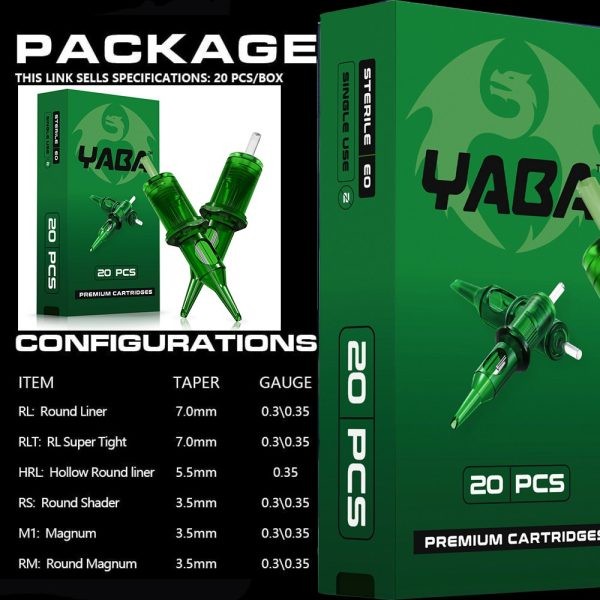
Check pack size and minimums before mixing sizes. Pro cartridges pack 20 needles per box, and some sizes in the range are OEM-only with a minimum of 10 boxes per size. A mixed order of six sizes can hit that minimum on the OEM-only codes, so confirm which codes carry it before the order is final. The needle size code guide walks through the code and pack checks in full.
Check the delivery against the code before shelving. Read the first two digits on each box when the order arrives and match them against the order list. A picking error between 10 and 12 codes is easy to make in a warehouse and hard to spot later, because the boxes differ by two digits only.
Keep both diameters coded separately in stock. If the studio runs #10 for grey work and #12 for bold work, store the boxes by code and not by the word bugpin. Two boxes with the same count and different first digits are different tools.
Ordering by code
Send the configuration list with full codes, box counts per code, and any logo or packaging requirements, and the quote will price the exact diameters you specified. If a size on your list is OEM-only, the reply will state its minimum before you commit to the mixed order.
Häufig gestellte Fragen
Q1: Are bugpin needles better than standard needles?
A1: Neither is better in general. Standard #12 wire moves more ink per pass and suits bold lines and fast saturation. Bugpin diameters move less ink per pass and suit fine lines and layered tone. The work decides which property you need.
Q2: What size is a bugpin needle?
A2: Most catalogues mean #10 at 0.30 mm, some include #08 at 0.25 mm, and a few suppliers use the word for #08 only. Read the first two digits of the cartridge code, which state the diameter directly.
Q3: Do bugpin cartridges fit my machine?
A3: Fit depends on the cartridge system your machine and grip accept, not on needle diameter. Pro cartridges fit all Cheyenne-type cartridge machines and grips, and other families publish their own fit.
Q4: Can one bugpin box cover lining and shading?
A4: The diameter can stay the same while the grouping changes. Lining and shading use different groupings, so a studio typically holds the same diameter code in both a liner and a shader or magnum grouping.