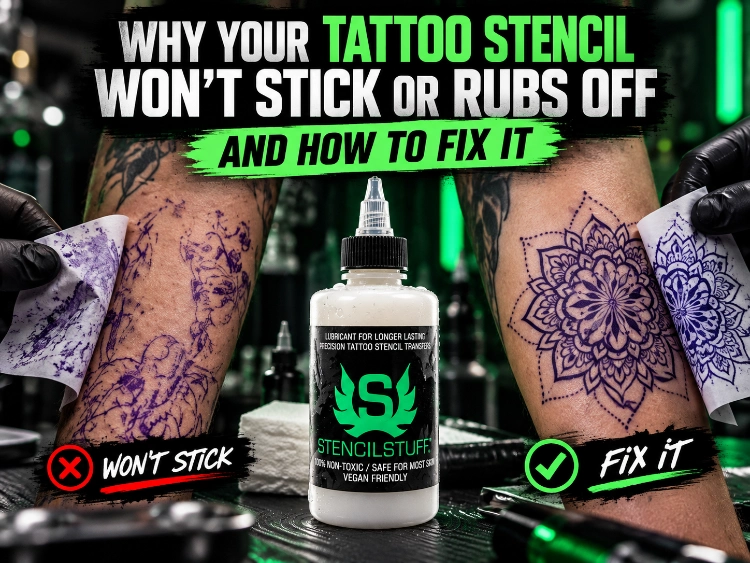
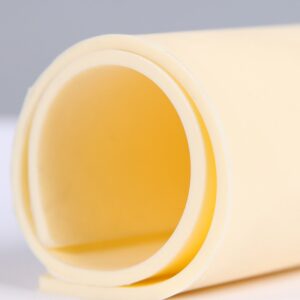
For Yaba silicone practice skin, our recommendation is to blot the loose ink with clean absorbent towel while supporting the sheet firmly. Examine the area after each pass and stop when another unused section of towel lifts no more ink. The practice lines should be visible for review at that point. Pursuing a blank sheet instead would keep the towel moving over material already punctured by the needle.
Wenngleich offers flat silicone practice sheets as well as a silicone-rubber arm-hold format. Match the support to the piece you are cleaning: a stable flat backing for the sheet, or support that maintains the arm-hold’s curve. The distinction you then need to make is between residue above the surface and marks belonging to the exercise. A chemical treatment must have care instructions covering the particular material and cleaner.
The mark you see determines what cleaning can accomplish
Loose ink should be lifted before you judge the practice lines
Begin beside the line whose edge is covered by a smear. Bring a clean section of absorbent towel into contact with that margin and lift it away. Check for the combination of ink collected on the towel and a clearer margin on the sheet. Before making another pass, find an unused section so that you do not put the collected ink back where you have just cleared it.
Use that same area for the next comparison. Has its edge become legible, and does ink still come away from the surrounding surface? These are checks on cleanup, whereas the darkness of the tattoo describes the practice result. A saturated line can remain dark after the surrounding loose ink has been removed.
If you can now examine the exercise, blotting has done the immediate job. There is no need to select an oil, solvent or remover merely to obtain a lighter-looking sheet. You would be adding treatment after reaching the inspection result you set out to obtain.
Embedded lines and physical cuts are different from surface residue
The remaining mark may be the practice line itself. The needle deposited ink into punctured synthetic material, so lifting residue from above it need not make the line disappear. Compare the mark with your design before deciding that more pressure is needed. If you have mistaken the tattoo for dirt, you will be rubbing after the surface-cleaning job has ended.
End work on a patch as soon as you can see a groove, tear or opened edge. Ink may lift from above it, but the damage remains. Even if the patch became paler, that altered surface would still interfere with your assessment of another exercise.
For a piece being kept, we look for lines that can be read and enough clear surrounding surface to examine them. A faint guide outside the tattoo may remain without preventing that assessment. You can preserve the practice result without restoring the sheet’s original blank appearance.
Steady support makes loose-ink removal easier to inspect
A flat sheet should stay still while clean contact lifts the ink
Support the material on backing that is clean and will stay steady. Our flat silicone practice sheets should remain against the backing as you clear them. Hold the part being touched from directly underneath, allowing the towel to lift ink while the sheet remains where you placed it.
Take the towel away from the sheet after blotting the pooled ink. Find a clean section before touching down again; a section carrying ink can deposit it over the patch you have just cleared. When a smear returns in this way, changing the contact surface addresses the cause. Pressing harder with the ink-loaded section does not correct the cause of the smear.
There needs to be enough unused absorbent towel left to see what it collects. Replace the towel when it no longer has enough unused absorbent area for that check. Compare the towel with the sheet after each pass, continuing while ink transfers and more of the work is exposed. End that step when clean towel collects no more residue, even if the tattooed lines are still dark.
The arm-hold sheet needs its curve supported during the same operation
Unser silicone arm-hold practice sheet uses silicone rubber for a curved practice setup. Let its support hold that curve steady while you lift loose ink. If your hand pulls a fold into the material, the view changes; a shadow or a surface change may then be difficult to distinguish from a smear that remains.

Make the before-and-after comparison on one small patch with the curve held in the same position. Blot between the inspections, retaining the setup used for practice. A flat exercise should stay flat for its comparison. Bending that sheet would not improve cleanup of the work it already carries.
Our reason for choosing the arm-hold format is a curved exercise; for a flat exercise, choose a flat sheet. That choice concerns the practice setup. It cannot establish resistance to all cleaners, and the material description silicone rubber is not sufficient to select a compatible solvent.
Remaining stencil marks do not justify an unverified cleaner
A guide that is still needed should remain visible
For unfinished work, first establish whether the remaining transfer line is still needed. Retain it if the next part of the design depends on it, lifting loose ink from around the guide. Removing it at this stage would make the exercise harder to continue.
On a completed exercise, the tattooed line, the transfer trace and damage to the sheet are separate things to assess. A trace of flat colour outside the design may affect its presentation, but it is not pooled surface ink. Once clean absorbent towel no longer collects residue, that action with extra pressure is not an established way to remove the trace.
Keep or photograph a legible piece with a guide remaining if that suits its intended use. Decide whether the trace actually needs more treatment before doing anything to it. A blank appearance is not required of every cleaned sheet, and pursuing it should not cost you a useful practice result.
Any further treatment must match the exact synthetic material
Confirm that any further method is permitted for both the particular practice skin and the cleaning product. Carry out its application and removal directions, including a trial on an inconspicuous unused area if required. These are instructions for the synthetic material involved and should not be used as care directions for a person with tattooed skin.
We require more than the product name stencil remover to establish suitability for silicone practice material. Use for skin preparation or for repositioning a guide on another surface does not establish that match. An oil or solvent recipe that worked for a different brand also leaves compatibility with this particular sheet unconfirmed.
Keep the trace untreated if a compatible method has not been identified. Removing the loose ink so that the exercise can be inspected is a useful result in its own right. Experimenting with a chemical requires separate evidence, which cannot be supplied simply by finding that blotting no longer lifts ink.
The final inspection decides whether to keep the work or retire the area
A clear view matters more than a completely colourless sheet
Follow the permitted method through to residue removal and drying before assessing the sheet. Look under steady light for loose ink that still transfers, practice lines you can read and physical damage. A wet or oily shine may conceal what you need to see, making those separate conditions hard to judge.
For a photograph, first clear the covering smear sufficiently to show the practice lines. Once you can examine the result against its surrounding surface, the piece can be kept. That is a useful end to cleaning even though colour remains; its presence alone is not a reason for another pass.
Where loose ink is still transferring, try fresh absorbent towel and inspect that area for improvement. Where only embedded lines or cuts remain, repeating the same cleanup will not resolve them. Stop working on that patch instead of extending treatment over the whole sheet.
New material is relevant only after the used area fails that inspection
Before choosing an unused area, check that old lines or damage would impair assessment of the next drill. If so, use intact space on the current sheet when enough remains. A sound unused area does not need replacing because you have cleaned a used patch elsewhere on the sheet.
Choose another practice sheet or training format when the current sheet has no suitable space left for the next exercise. Our flat range includes 15 × 20 cm and 20 × 30 cm formats. A drill that fits the smaller footprint does not need the larger one; choose more area when the drill requires it. Size is a space decision and does not establish that a used design can be washed away.
State the space occupied by the exercise and whether it needs a flat or curved setup when requesting replacement supplies. You have then carried the inspection of usable area through to the next drill’s requirements. The request specifies training material rather than prescribing a stain-removal treatment for the existing piece.
Abschluss
If inspection leaves too little intact space for the next drill, send Yaba the required format, exercise footprint and quantity when asking about replacement sheets.
Häufig gestellte Fragen
Q1: Why does the practice design remain dark after blotting?
A1: Ink inside the punctured material can leave the practice line dark after surface blotting is finished. Check the surrounding area for ink that still transfers. The design’s darkness, taken alone, does not establish that you should press harder or select another cleaner.
Q2: Is a stencil remover suitable for the guide left on my practice skin?
A2: Only a method confirmed for the exact synthetic practice material and product establishes that pairing. A skin-preparation purpose or another brand’s recipe does not establish that pairing. If the work is readable and no compatible method is identified, keep the trace untreated.
Q3: When is another practice sheet actually needed?
A3: Consider another sheet if old marks or damage would prevent you from assessing the next exercise and insufficient intact unused space remains. Make that decision after clearing loose ink and inspecting the current sheet. Some colour remaining is not enough reason to replace the whole sheet.