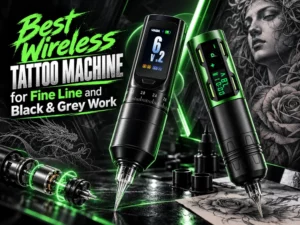
Fine line work is decided at the low end of a machine. Stroke first. Then the size of the voltage steps. Then weight. A pesar de sells two wireless machines an artist would compare for this work. The touch screen wireless kit is $159. The InkOne pen is $59. Each page states its own figures. A figure read on one page stays on that page.
Measure the work first. Then open the listing whose stated figures cover it. The morning can hold a single-needle script client. The afternoon can hold a black and grey sleeve. Two sittings, two settings. One machine holds both settings, or the studio buys a second machine.
Set the standard first: what fine line work asks of a machine
A stroke that cannot come down leaves voltage doing two jobs
Fine line artists work inside a stroke window of about 2.5 to 3.5 mm. The needle travels a short distance. It enters, it leaves, and the line on the skin is the line the hand drew.
A pen with a fixed stroke of 3.5 mm sits at the top of that window. A 7RL grouping can work at the top of the window. A single needle has a harder time there. The hit lands harder than hairline work wants, so the artist lowers the voltage until the hit feels softer. Now voltage does two jobs. It sets the speed, and it covers for the stroke. The setting where the line ran clean can sit between two settings the machine holds.
Read the stroke line before the voltage line on any listing. Maximum stroke and maximum voltage at the top of a page describe a packing machine. The title above those numbers cannot change them.
Voltage steps of 0.1 V land where 0.5 V steps jump over
The gap is small. On skin that takes fine line work well, a clean line and a blown line can sit 0.3 V apart. A machine stepping in 0.5 V jumps cannot stop inside a 0.3 V gap. The step below is offered. The step above is offered. The step in the middle, where the line ran clean, is not on that machine. The artist slows the hand and covers the difference with speed.
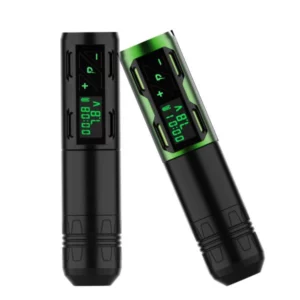
Working voltage on the InkOne page: 5 to 12 V. The detail line under it gives the adjustment in 0.1 V increments. The display shows the setting. The display shows the battery left. Two readings, one small screen. An artist whose lining sits at 6.8 V sets 6.8 V. Give step size the same place in the comparison as stroke and weight. It is printed on the page with them. Colour and brand come after it.
Weight and balance decide the last hour, not the first
Every pen feels light for ten minutes. Hour four of a black and grey session is the test. The hand starts correcting for the pen, and the corrections enter the blends as pressure changes. The InkOne page states a net weight of 197 g. Battery compartment included. Size on the same page: 32 mm by 142 mm. Compare them with the pen on your bench at the end of its longest day.
Vibration is settled on practice skin, not in a table. Draw the long line at your lining voltage. The line shows the shake, or it shows none. A drawn line is evidence. A description is a claim. The arrival checks near the end of this article run that test before the machine is trusted with a client.
Fine line settings: needle, stroke and voltage as one setup
The machine is half of the setup. The cartridge is the other half, and the needle grouping changes what a stated stroke and a stated voltage will do on skin. The three are set together. The starting points below are the ones we give artists who buy from us. The skin in the chair outranks any line in this article.
Single needle and tight 3RL work
Stroke sits at the bottom of the window: 2.5 to 3.0 mm. Voltage starts low. Start it low enough that the test line on practice skin looks almost too light. A setup can be walked up in small steps during the first pass. A setup that starts hot has to be calmed down on the client’s skin. On the InkOne, this work usually begins between 5.5 and 7.5 V and moves in the 0.1 V steps that page states.
Needle depth is the third setting. The touch screen kit page states an adjustable needle depth from 0 to 4.2 mm. An exposure can be set, noted on the day sheet, and set again after a break. Hand pressure is a poor memory, and the client pays for the lesson when the guess is wrong.
5RL to 7RL: lines that still need control
A 5RL carries more ink than a 3RL. A 7RL carries more again. The setup follows the grouping. Stroke goes up, into the 3.0 to 3.5 mm band. Voltage goes up with it, a few tenths above the single-needle setting. The needle changed. The numbers change with the needle. Asked to lay a visible line at single-needle settings, a larger grouping drags.
This band is where a fixed 3.5 mm stroke stops costing the artist anything. It is also the band that explains the adjustable machine: the pen that sat at the bottom of its range for the morning’s script client moves one setting for the afternoon, and the hand keeps the grip it already knows.
Round shaders and small magnums for soft grey
A gradient is one pass, repeated. On a large piece the count reaches forty passes. Pass forty has to land like pass ten. Stroke: the middle of the window. Voltage: low. The cartridge does half of this work before the machine is switched on. Round shaders lay the ink one way. Curved magnums lay it another. The blend needs one of those patterns, and the grouping supplies it. That is why the groupings stocked in a cartridge range belong in a machine decision.
Black and grey: the same machine, a different demand
A fast lining pass ends before a small drift in output adds up. A three-hour blend keeps every change. The grey dries in stripes, usually in the lightest passages, where the least ink covers the evidence. Letters about striped grey rarely end with the artist’s hand. They end with a battery that fed the machine less in the third hour than in the first, or with voltage steps that built the middle greys in jumps.
Black and grey is the fine line standard held for three hours. Fine steps. Output that holds at half charge. A dot mode for stipple and whip-shaded textures: the touch screen kit page lists a dot mode function beside the adjustable stroke. Colour packing hits harder and sets up on different numbers. It has its own article, on wireless machines for fast colour packing and solid blackwork.
One adjustable-stroke machine across both jobs
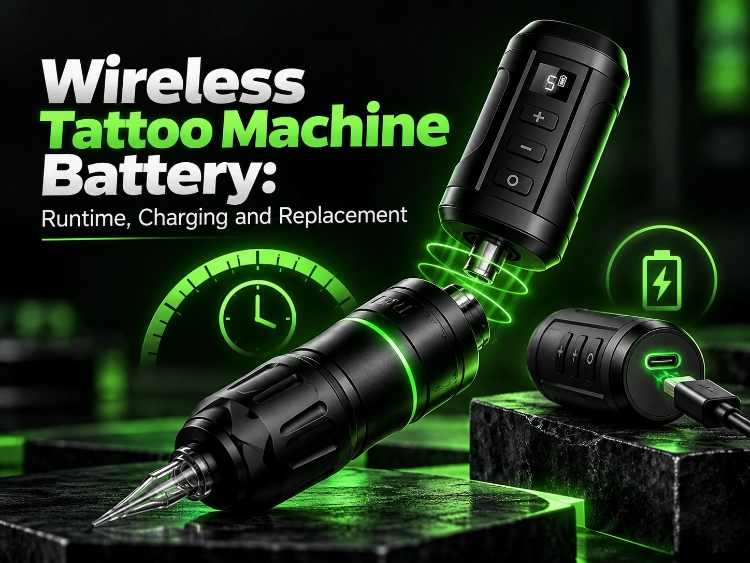
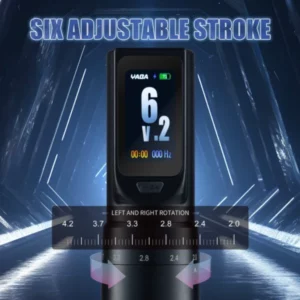
El touch screen kit page, read as one listing. Adjustable stroke function. Dot mode function. Jump start function, for cartridges that hesitate at low voltage. Work timing and Herz function on the display while the machine runs. Space aluminum material. Type-C port for fast charging. A grip diameter of 38 mm. A battery capacity of 2400 mAh. Adjustable needle depth from 0 to 4.2 mm. The kit switches between its power pack and an RCA plug. A flat battery at a guest spot asks for a borrowed cable. The appointment stays on the book.
The same page states the box: one battery pen, an extra battery, an RCA plug, a clip cord, a Type-C cable. Price on the page: $159, down from $199.
Read the two machines as two listings, because that is what they are. The kit page states its figures one way. Adjustable stroke. Needle depth from 0 to 4.2 mm. A 2400 mAh battery. A grip of 38 mm. The InkOne page states a different set the other way. Fixed stroke. A 5 to 12 V range. A weight of 197 g. A figure is never carried from one page onto the other machine. Every setup in this article takes its numbers from the machine it describes.
Count the cost the way it arrives. A fixed-stroke pen covers the work it was built for. A full diary holds more work than that. The rest asks for a second pen. It asks for a second battery system, and a second set of spares. One adjustable machine, spare battery already in its box, costs less for a plain reason: the second purchase never happens.
The budget pen: where the InkOne fits and where it stops
The InkOne is $59, down from $129 on its page. The specification is a fixed-stroke one. Stroke line: 3.5 mm. The adjustment at the base sets the needle length. Two lines, one machine: a fixed 3.5 mm stroke, needle length adjusted at the base.
The rest of that page: 10800 rpm rotating speed, the 1800 mAh battery, and a stated running time of 5 to 10 hours depending on usage. For everyday lining with 5RL and 7RL groupings, for small traditional work, for 0.1 V control in a 197 g pen, the trade is fair. Single-needle fineline at the bottom of the stroke window belongs to the adjustable kit above. Two machines, two assignments. The range is divided that way on purpose. An artist who buys the InkOne for the work in this paragraph keeps it for years. The pen and the work match.
Ten-minute checks when the machine arrives
Practice skin. One needle from the batch you tattoo with. Ten minutes, before a client sits down.
Draw the longest line the practice skin allows at your lining voltage. Read the second half of the line. Drift and shake arrive after the hand settles into the movement. The first half flatters every machine in the catalogue. Then run the battery down and draw the same line at the same setting. A pen whose output follows its charge draws the second line weaker. That fade is the one waiting in the last hour of a grey session.
Set the needle depth. Change it. Set it back to your mark. A control that cannot return to a mark is a guess with a dial on it. Make the changes wearing gloves, as you would mid-session. A change that needs the machine opened on the bench gets skipped under time pressure. Count it as a setting the machine does not have. A machine, in the end, is the settings its artist actually uses at hour three.
Conclusión
This work is bought at the low end of a machine. Stroke that reaches the fine line window. Voltage in tenths of a volt. Weight the hand forgets by the third hour. A battery arrangement that does not end the session. The touch screen kit answers with an adjustable stroke, a dot mode and the spare battery in the box, at $159. The InkOne answers at $59, with 0.1 V steps and a fixed 3.5 mm stroke stated on its own page. Both sit in the wireless machine range, with the batteries and the cartridges that complete these setups listed beside them.
Preguntas frecuentes
Q1: Which tattoo machine is best for fine line tattooing?
A1: One that works at the bottom of the stroke window, 2.5 to 3.0 mm, and adjusts voltage in steps small enough to stop between a clean line and a blown one. In our range, that reading points to the touch screen wireless kit for adjustable work. The InkOne is the fixed-stroke option at the lower price, for lining in the 5RL and 7RL band.
Q2: What needle size is best for a fine line tattoo?
A2: A single needle draws the finest line. A tight 3RL sits one step wider. 5RL and 7RL groupings take over where the line has to carry more ink and read at a distance. The grouping works inside a setup: stroke at the bottom of the window for the single needle and the 3RL, voltage started low, needle depth set on the machine and repeated. A fine grouping run at packing settings is a wide line with a fine needle in it.
Q3: What voltage is best for fine line tattoos?
A3: No single figure is honest. The right voltage moves with the machine, the grouping and the client’s skin. Most fine line work starts low. On the InkOne, between 5.5 and 7.5 V covers most starts, adjusted in 0.1 V steps until the line sits clean. A machine that steps in 0.5 V jumps makes the search harder, because the gap being searched is often near 0.3 V.
Q4: What stroke is best for lining?
A4: A short one. The window runs from 2.5 to 3.5 mm. The single needle sits at 2.5 to 3.0 mm. A 5RL and a 7RL sit at 3.0 to 3.5 mm. Longer strokes belong to colour packing, where the needle moves ink in volume instead of placing a hair of it.